
The 5-Minute Rule: Why Speed-to-Lead Is Your Easiest Sales Win
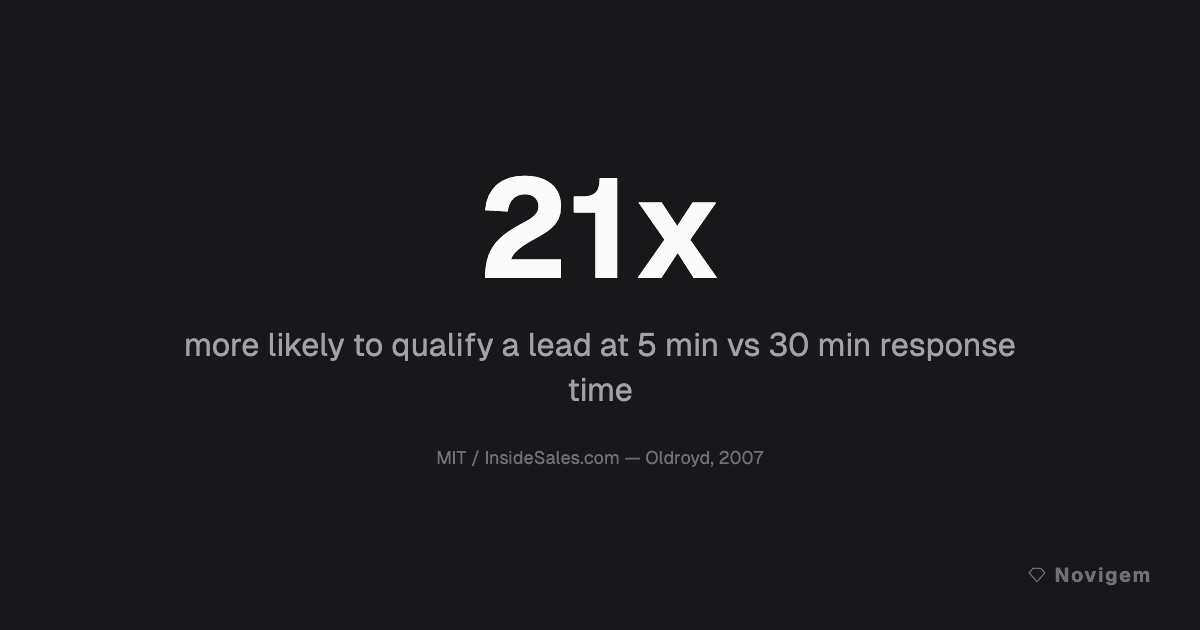
Here's a stat that should change how you run your sales team today: contacting a lead within 5 minutes of their inquiry makes you 21x more likely to qualify them compared to waiting 30 minutes (Oldroyd, 2007). It is one of 40+ sourced sales and CRM statistics we keep current.
21x More likely to qualify a lead when you respond within 5 minutes versus 30 minutes. MIT/InsideSales.com Lead Response Management Study (Oldroyd, 2007)The MIT/InsideSales.com study analysed over 15,000 leads across multiple companies. The data is unambiguous. The first five minutes after a lead raises their hand is the most valuable window in your entire sales process. And most teams waste it.
The math is brutal
The same study found that responding within one hour versus after one hour makes you 7x more likely to qualify the lead (Oldroyd, 2007). Wait 24 hours, and your odds drop by 60x compared to that first hour (Oldroyd, 2007).
Think about what that means for your pipeline. If your team's median lead response time is 4 hours, which is common, you're not just a little late. You're operating at a fraction of the conversion potential of a team that responds in 5 minutes. Nothing else changed. Just speed.
Every hour of delay isn't a small inefficiency. It's a pipeline leak.
The mathResponding within 1 hour vs after 1 hour = 7x more likely to qualify. Wait 24 hours and your odds drop by 60x compared to that first hour. If your median response time is 4 hours, you're operating at a fraction of your conversion potential.
Why most teams can't crack 5 minutes
The frustrating thing about speed-to-lead is that everyone knows it matters. Your reps have heard the stat. It was in the onboarding deck. Maybe it's on a slide somewhere in your enablement portal.
And yet, the leads from Tuesday are still untouched on Thursday.
Three reasons:
New leads compete with active deals. When a new MQL drops in, the rep is mid-conversation with an existing prospect, prepping for a demo, or updating their pipeline for the weekly review. The new lead gets triaged as "I'll get to it later." Later turns into tomorrow. Tomorrow turns into never.
There's no consequence for being slow. Most teams track whether leads get contacted, but not how fast. As long as the rep eventually reaches out, the metric is green. A 3-minute response and a 3-day response look identical in most Salesforce reports.
And speed isn't rewarded. Even if a rep drops everything and calls a lead within 2 minutes, nobody notices. The rep who responds in 2 minutes and the rep who responds in 2 days get the same feedback: none.
Making speed the default behaviour
This is a problem that behavioural design can solve without hiring more reps or changing your lead routing.
Start by making response time visible. A Salesforce report showing median response time per rep, updated daily, changes the dynamic overnight. Nobody wants to be last on a list their manager sees every morning (Festinger, 1954).
Give reps a specific number to hit, not a vague direction. "Respond faster" changes nothing. "Respond within 15 minutes" does. Specific, challenging goals produce better results than vague encouragement (Locke & Latham, 1990).
The trickier part: reward the behaviour, not just the outcome. The rep who calls a lead in 3 minutes doesn't always get the meeting. That's fine. The behaviour is right even when the outcome isn't. If you only reward booked meetings, you're rewarding luck as much as speed.
Once you've got visibility and a threshold, gamify it. A "First Responder" challenge: points awarded the moment a rep logs a first touch within the window. Double points for under 5 minutes. A weekly "Fastest Hands" badge.
The SAP Sales Challenge used structured competition to drive specific behaviours and measured a 32% improvement in sales productivity (Ahmed, 2025). Speed-to-lead is exactly the kind of specific, measurable behaviour that responds well to gamified incentives.
Why this is the easiest win in your org
Most sales improvements need new tooling or more headcount. Speed-to-lead needs neither. Your reps already know how to call people. Your leads are already in Salesforce. Everything is in place.
The only thing missing is the incentive to move fast.
That's what makes this the easiest win. You're not building something new. You're removing friction from something your team already does, and creating a reason to do it faster.
Run this experiment: for the next two weeks, track median response time per rep and make the leaderboard visible to the team. Don't add a prize. Don't send a nagging Slack message. Just make the number visible.
Then watch what happens.
Want to turn speed-to-lead into a permanent advantage? Novigem tracks response time automatically and rewards fast follow-up inside Salesforce. See how the leaderboard and badge system keeps reps competing, or estimate your ROI.