
How to Gamify Salesforce: A Practical Guide for RevOps Teams
Most Salesforce gamification fails because it's treated like a gimmick. Slap a leaderboard on your Salesforce dashboard, hand out a gift card at the end of the month, call it gamification. Two weeks later, nobody cares and the leaderboard widget gets moved below the fold.
That's not gamification. That's a SPIFF with better graphics.
Real gamification changes behaviour. It makes reps want to do the things that make your pipeline accurate and your managers less dependent on weekly nag sessions. Not because someone announced a contest in Slack, but because the system design makes good behaviour feel rewarding on its own.
I've spent the last year building a gamification programme for Salesforce and watching what happens when teams actually adopt it. This is the guide I wish existed when I started.
What Salesforce gamification is (and what it isn't)
Salesforce gamification is applying game design principles to your CRM. In practice, that means taking the behaviours you want from reps: logging activities, updating stages, maintaining clean data, responding to leads quickly. The system of incentives makes those behaviours self-reinforcing.
A one-off contest is a SPIFF. A dashboard with a trophy icon is decoration. And if your "gamification" is really just a public shaming tool disguised as competition, that's a management problem, not a game design one.
What separates gamification from a contest is permanence. A SPIFF starts and stops. Gamification runs continuously in the background, scoring and recognising the daily work that compounds into results over time. That continuity is why teams end up buying Salesforce gamification software rather than running contests by hand.
Think of the difference like this: a SPIFF is a crash diet. You lose weight for two weeks and then rebound. Gamification is a nutrition plan. Less dramatic day-to-day, but it actually changes what people do. We wrote more about why SPIFFs fade after two weeks if you want the behavioural science behind that pattern.
SPIFF vs gamificationA SPIFF starts and stops. Gamification runs continuously in the background, scoring and recognising the daily work that compounds into results over time.
Why it works: the short version
You don't need to understand behavioural psychology to run a gamification programme. But it helps to know why the mechanics produce results, because it tells you which ones to use and when.
The research boils down to a few ideas that actually matter in practice.
The biggest one: the gap between action and reward determines whether a behaviour sticks. Reinforcement theory (Skinner, 1953) isn't complicated. Points awarded the moment a rep logs an activity create a stronger habit loop than a bonus three months from now. If the reward is delayed, the brain doesn't connect it to the behaviour. Most SPIFFs fail here.
Then there's peer comparison. Festinger (1954) showed that people calibrate their effort based on where they stand relative to others. That's why leaderboards work: when a rep sees they're two points behind a colleague, they try harder. But this cuts both ways. A leaderboard with a runaway leader kills motivation for everyone else. The comparison has to feel closeable.
Weekly challenges outperform quarterly targets because specific, time-bound goals produce better results than vague ones (Locke & Latham, 1990). "Log 5 quality activities this week" changes behaviour. "Improve your pipeline this quarter" changes nothing.
And there's a reason gamification works better than top-down mandates. Deci & Ryan (1985) found that people need to feel some autonomy over what they're doing, see themselves getting better at it, and feel connected to the people around them. Gamification, when it's designed well, gives reps all three. They pick which challenges to focus on. They watch their streaks grow. They compete with people they actually know.
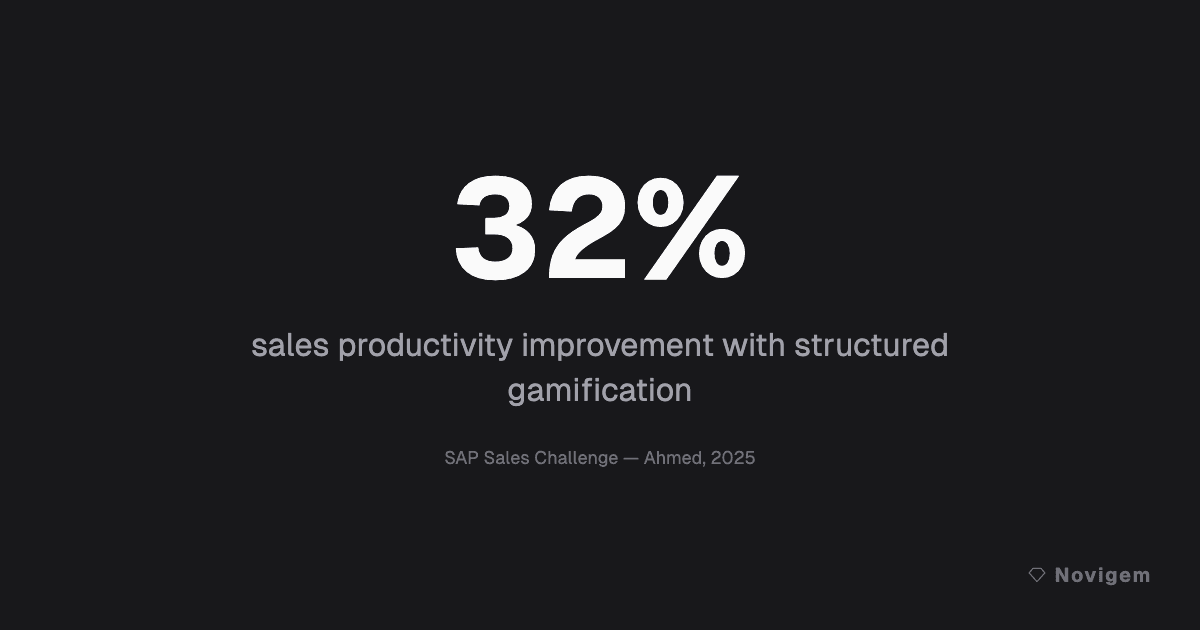
32% Sales productivity improvement from structured gamification: competitions, leaderboards, and achievement mechanics applied consistently. SAP Sales Challenge (Ahmed, 2025)A meta-review of 24 peer-reviewed studies found the majority showed positive effects on engagement and motivation, though the results were context-dependent (Hamari et al., 2014). That doesn't mean gamification always works. It means the mechanics are sound, if you design the programme to fit your situation.
The five core mechanics
Every gamification system is built from some combination of these five building blocks. You don't need all of them on day one. Start with two or three that address your biggest pain points.
1. Points
Points are the foundation. They create the immediate feedback loop that reinforcement theory says you need.
Award points for specific behaviours: logging an activity, updating a next step, moving a deal to a new stage, responding to a lead within 15 minutes. This seems obvious, but most teams get it wrong by rewarding volume instead of quality. If you give points for "most calls made," you'll get a lot of junk calls.
Weight them. A discovery call with notes and a next step logged should earn more than a "left voicemail" activity. Updating an opportunity's close date proactively should earn more than just moving the stage forward. The weighting tells reps what you actually value.
2. Leaderboards
Leaderboards activate peer comparison. They can be the single most effective mechanic you run, or the one that makes half your team check out. It depends entirely on how you set them up.
The rules: segment by role. AEs, SDRs, and CS reps should not compete against each other. They do different work. Reset weekly. A monthly leaderboard becomes fixed after week one and stops motivating anyone in the middle of the pack. Show the full list, not just the top three. Reps care about moving from 8th to 6th, not just about hitting first place.
One more thing before you put the board on a TV on the sales floor: a wall display amplifies whatever your leaderboard already does, the good and the bad. We wrote about what belongs on a sales leaderboard TV screen, including what to leave off.
3. Badges
Badges recognise exceptional or sustained behaviour. They work differently from points. Points are transactional (do the thing, get the points). Badges are identity-based ("I'm the kind of rep who maintains forecast integrity").
A "Pipeline Honest" badge for reps who close-lost stale deals instead of letting them rot. A "First Responder" badge for consistent sub-5-minute lead response. You get the idea. The specific badges matter less than the fact that they're visible and that other people notice them. The social recognition is what drives the behaviour, not the badge itself.
4. Streaks
Consistency is the hardest behaviour to create. A rep who logs activities 3 out of 5 days isn't building habits. A rep who does it every day for three weeks straight is. Streaks are how you get there.
Streaks work because breaking them feels costly. Duolingo figured this out: people will do a language lesson they don't feel like doing just to maintain their streak. The same psychology applies to logging a next step in Salesforce at the end of the day.
Start with daily streaks for core behaviours (activity logging, pipeline updates). Then add weekly streaks for harder behaviours (maintaining close date accuracy, hitting response time targets).
5. Challenges
Challenges are time-bound missions. "This week: every opportunity past Discovery needs a contact role assigned." They work best as 1-2 week sprints. Any longer and people lose interest; any shorter and you're just creating noise. Stack them with the other mechanics (points for completing tasks, a leaderboard for the challenge period) and they become the thing your team actually talks about on Monday morning.
The behaviours worth gamifying
Not everything in Salesforce should earn points. If you gamify too many things, nothing feels important. If you gamify the wrong things, you'll incentivise behaviour you don't want.
Based on the problems I see most often in Salesforce orgs, these are the behaviours where gamification moves the needle.
The obvious one is data entry consistency. Reps skip logging activities, next steps, and contact roles because they get nothing back for doing it. Flip the incentive and the behaviour changes. I wrote a full post on how to incentivise Salesforce data entry without manual SPIFFs.
Stage progression is less obvious but arguably more damaging. Deals sitting in the same stage for 45 days wreck your forecast and inflate your coverage ratios. Reward reps for moving deals forward with valid next steps attached. Reward them for close-losing dead pipeline too. That deal was already dead. The rep just made your forecast more accurate. More on the hidden cost of inconsistent stage progression.
21x More likely to qualify a lead at 5 min vs 30 min response time. Most teams know this stat and still respond in hours. Oldroyd, 2007Speed-to-lead is the easiest win. Gamify the response time itself, not just the meeting outcome. We broke this down in The 5-Minute Rule.
Then there's the broader data quality stuff: contact role coverage, close date accuracy, next step completion rates. These are the 7 metrics that impact forecast accuracy. Each one can be tracked per rep, put on a leaderboard, and rewarded for improvement.
And meeting quality. Not just "did you have a meeting" but "did you log notes, set a next step, and follow up within 24 hours." Quality-weighted points prevent reps from padding their numbers with junk activities.
The mistakes that kill most programmes
I've watched gamification programmes die the same five ways. If you're planning one, this is the section to pay attention to.
Rewarding volume instead of quality
The most common mistake. "Most activities logged" becomes a race to the bottom. Reps spam "left voicemail" entries to climb the leaderboard. You end up with higher activity numbers and worse data quality than before. Weight your points toward quality signals instead. A logged call with notes and a next step earns 5 points. A bare "left voicemail" earns 1. The leaderboard should reward the rep who does fewer, better activities.
Running it as a one-time contest
A gamification "programme" that runs for one quarter and then stops is just an expensive SPIFF. The behaviour gains evaporate the week after it ends. The core mechanics (points, streaks, weekly leaderboard resets) should run continuously. You can layer in time-bound challenges for variety, but the base system stays on.
Unfair comparisons
Putting a new SDR on the same leaderboard as a 10-year AE is demoralising, not motivating. People disengage when the comparison feels rigged (Festinger, 1954). Segment by role, tenure, or territory. Recognise improvement, not just absolute numbers. The rep who goes from 3 activities per day to 7 has improved more than the one who was already at 8.
No manager buy-in
This one is subtle. If managers don't reference the programme in their coaching, reps treat it as background noise. The leaderboard exists but nobody talks about it. Points accrue but nobody celebrates milestones. The programme needs to show up in your pipeline review. Start each meeting with the leaderboard. Mention streaks. Call out badge earners. If it's not part of the management rhythm, it doesn't exist.
Over-engineering from the start
Launching with 15 different point categories, 30 badges, and a complex tiering system. Reps get confused. Nobody knows what earns what. The programme feels like more work, not less. Start with 3-5 behaviours that earn points, one leaderboard, and two badges. Run it for four weeks. See what works. Then expand.
Launch checklist3-5 behaviours that earn points. One leaderboard, segmented by role. Two badges for sustained behaviours. Run for 4 weeks. See what works. Then expand.
How to measure whether it's working
Gamification should produce measurable improvements in specific behaviours within weeks. If you can't show lift after 6 weeks, something is wrong with the design, not the concept.
Baseline first
Before launching anything, capture your current numbers. You can't claim improvement if you don't know where you started.
Measure at the rep level, not the team aggregate. Team averages hide individual problems. The numbers to capture: average activities logged per rep per day, median lead response time, percentage of opps with contact roles, average days in stage, close date accuracy, and how much time managers spend chasing updates.
Weekly lift tracking
Once the programme is running, compare weekly metrics against that baseline. Activity volume and quality should trend up. Lead response time should trend down. You want to see fewer deals stuck in the same stage and more complete records. If managers are spending less time on administrative chasing, that's a strong signal too.
The signals that matter most
Activity volume alone is a vanity metric. What actually tells you the programme is working:
Are deals moving through the pipeline faster? Stage progression rate is the clearest signal that reps are actively working deals instead of letting them sit.
Are close dates becoming more reliable? This is the downstream effect of better stage data, and it's the metric your CRO cares about most.
Are managers spending less time chasing updates? Hard to measure precisely, easy to feel. Ask them.
What percentage of the team is actually engaging? If only 3 out of 15 reps are earning points, the design needs work. You want 70%+ participation or something is off.
The 6-week pilot model
The fastest way to prove gamification works for your team:
Week 1-2: Define weighted KPIs and capture baselines. Configure the programme around 3-5 core behaviours. Keep it simple.
Week 3-4: Run challenges and nudges. Weekly goals, real-time recognition, leaderboard resets every Monday. This is where you see the first behaviour changes.
Week 5-6: Compare lift against baselines. Document improvements. Decide what to scale and what to adjust.
If you've designed the programme around the right behaviours and the mechanics are working, you should see measurable movement by week 3. The field evidence is encouraging: a natural field experiment across 24 KPMG offices over 29 months found that offices running gamified training collected 36% more fees, signed 16% more clients, and generated 22% more new business opportunities than non-participating offices (Buell, Cai & Sandino, 2023).
Why Salesforce-native matters
One thing I feel strongly about. Gamification tools that live outside Salesforce create friction. If reps have to log into a separate app to see their points, most of them won't. Data syncs introduce delays, and even a 15-minute gap between logging an activity and seeing your points update is enough to break the habit loop.
The programme needs to live where the work happens. We cover exactly what Salesforce-native gamification means in practice: the architecture difference, what you can score, and how it compares to external sync tools. The brain connects action to reward only when the gap is short. That means points inside Salesforce, leaderboards in the same view reps already use, badges on their profile. No tab switching.
If you're comparing tools, it's worth reading how Salesforce-native options differ by team size and pricing. We've written a detailed breakdown of how Novigem compares to Ambition for teams that are outgrowing DIY approaches but don't need enterprise-scale complexity.
Getting started
If you've read this far, you probably already have a specific problem in mind. Pipeline hygiene, speed-to-lead, reps ignoring the CRM fields you spent weeks building. Whatever it is, start there.
Pick the one behaviour that would have the most impact if every rep did it consistently. Build the programme around that. Measure the baseline, run it for 6 weeks, see what happens.
Complexity can come later. Getting buy-in from a confused team is much harder. And if you're hoping a leaderboard alone will fix a broken incentive structure, it won't. Gamification is a system, not a feature.
If you want to see how this works inside Salesforce, Novigem turns the behaviours in this guide into automated challenges with points, badges, and leaderboards, all native to your Salesforce org. Start with a 6-week pilot and measure lift against your baseline.