Putting the Leaderboard on the Wall
Walk into enough sales offices and you will see the same screen. A leaderboard, fifteen names, updated live, mounted where everyone can see it. Sometimes it is doing real work. More often it has become wallpaper that nobody has looked at properly since the month it went up.
The screen is not the variable. What is on it is.
Why a wall display is different from a dashboard
A dashboard is something a rep opens. A wall display is something a rep cannot avoid.
That difference is the entire point, and it is also the risk. Anything you put in front of someone continuously stops being information and becomes a fact about their working life. If the screen says the same person is winning, every day, for six weeks, you have not built a competition. You have built a monument.
We wrote about this in the context of weekly resets: a leaderboard that never resets trains the bottom of your team to stop competing, because their ranking stops reading as a score they can move and starts reading as a description of who they are. Put that same permanent leaderboard on a wall and you have not fixed anything. You have raised the volume.
So the first rule of a sales TV screen is uncomfortable: it amplifies whatever your leaderboard already does. If the underlying design is sound, visibility compounds it. If it is not, visibility compounds that instead.
What earns a place on the screen
Three things tend to work.
A score that can still move today. A weekly or monthly window, not an all-time total. The question a rep should be able to ask the screen is "can I change this before Friday", and the answer has to be yes for most of the room, not just the top three.
Recent events, not just standings. A ranking is a snapshot and it updates slowly. A feed of what just happened, a deal moved, a call logged, a badge earned, updates constantly and gives everyone something to be part of. It also solves the wallpaper problem: a screen that changes is a screen people glance at.
The behaviour, not only the outcome. Closed revenue is a lagging number that a handful of people control. Activity that anyone can do today is a leading one. A screen showing only won deals tells most of your team that the screen is not about them.
What to leave off
Anything that shames. A bottom-three list, a red row, a name attached to a failure. It reads as motivating to whoever designed it and as a threat to whoever is on it. The people it targets are the people least able to respond to it.
Numbers with no context. A figure nobody can interpret at a glance is noise, and noise is how a screen becomes wallpaper.
Personal targets, if your floor is shared. A wall display is public by definition. Quota attainment is not always a public number, and treating it as one because the tooling made it easy is a decision worth making deliberately rather than by default.
The visibility problem nobody mentions
There is a practical failure that comes up more than any of the design questions: the screen shows the wrong people.
An org-wide leaderboard on the wall of one office means most names on it belong to people nobody in that room has met. Sales in Amsterdam do not benefit from watching Service in another country, and a rep who is fourteenth org-wide might be second in the team standing next to them. Scope the screen to the team in front of it, or it is showing a competition that is not happening in that room.
What we built
Novigem's wallboard is live at dashboard.novigem.com.
It is a fullscreen display for a TV: leaderboard, points over time, a live feed of what just happened, and celebrations that pop when somebody earns something. It reads your Novigem data directly and updates in real time.
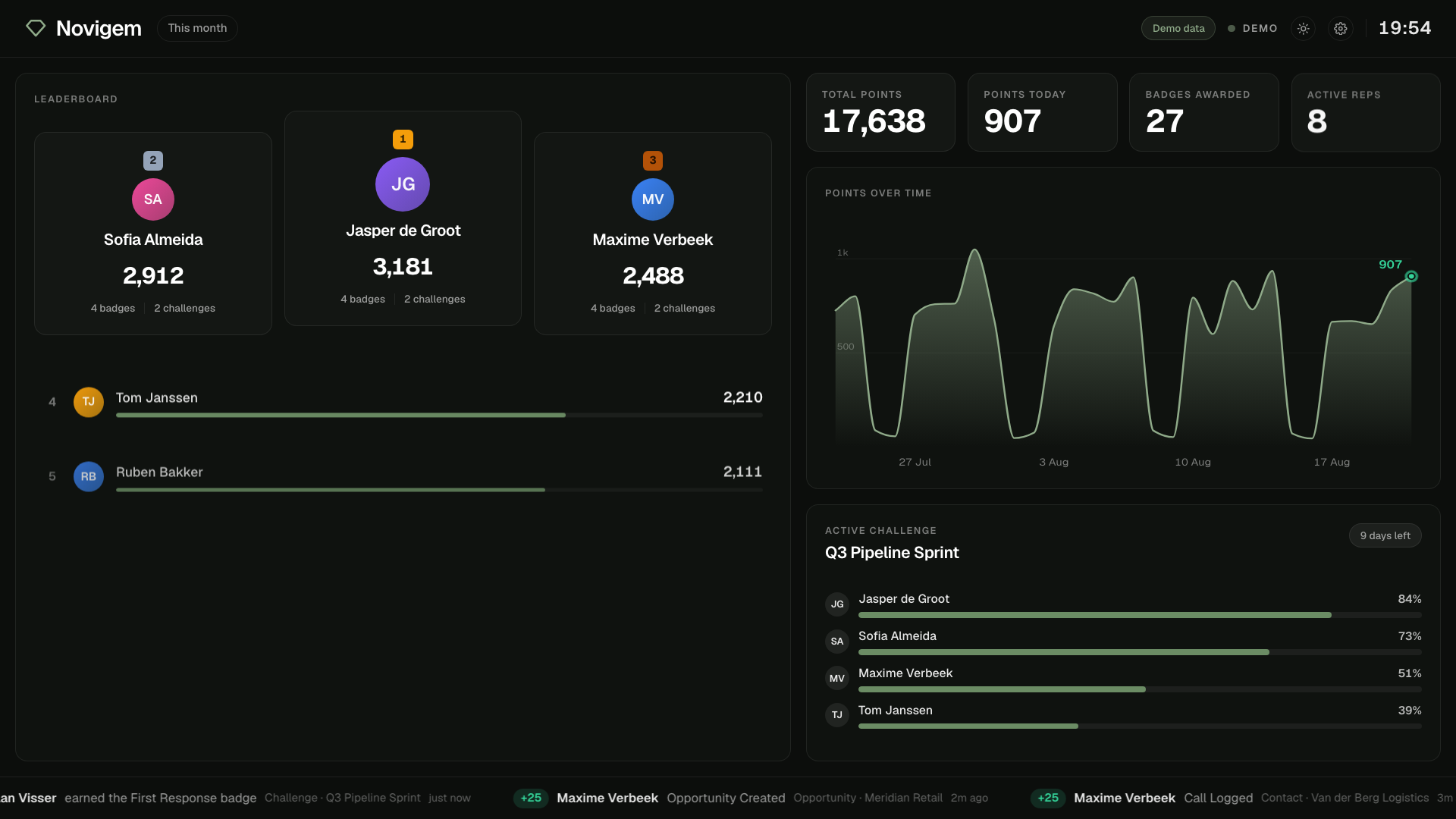
That is demo data, not a customer's org. Note what the layout is doing, though: the podium is only three names deep, and the ranked list underneath carries everyone else with a progress bar rather than a gap. Fourth place is not a loser's position on this screen, which is the whole point of the section above.
A few decisions in it follow from the argument above rather than from a feature list.
It scopes to a team. Point a screen at Sales Amsterdam and it shows Sales Amsterdam. A different screen on a different floor shows a different team. That is a Salesforce Public Group, so the grouping already exists in your org and you are not maintaining a second list of who sits where.
It shows the window you choose. Week, month, quarter, or all time, pinned per screen, so the score on the wall is one people can still move.
Every screen signs in for itself. A TV, a laptop, a phone in a warehouse: each one authenticates with Salesforce directly, and every query runs as that signed-in user. Which means your sharing rules decide what appears on the screen, exactly as they do everywhere else in Salesforce. There is no service account with a view of everything, and no copy of your pipeline sitting on our servers. The wallboard reads, and only reads.
That last point is worth being plain about, because it is the part most people assume is a detail and it is not. Putting your sales data on a wall is already a decision about who sees what. It should not also become a decision about who else holds a copy of it.
Before you mount anything
Ask what a rep in the middle of the pack sees when they look up.
If the answer is a number they can move this week, a feed they are part of, and a team they recognise, the screen will do work for you. If the answer is a permanent ranking of people they cannot catch, it will do work against you, and it will do it every single day, at scale, in a way a dashboard nobody opens never could.
The screen is a multiplier. Get the leaderboard right first.