
How to Run a Sales SPIFF in Salesforce (And What to Add So It Lasts)
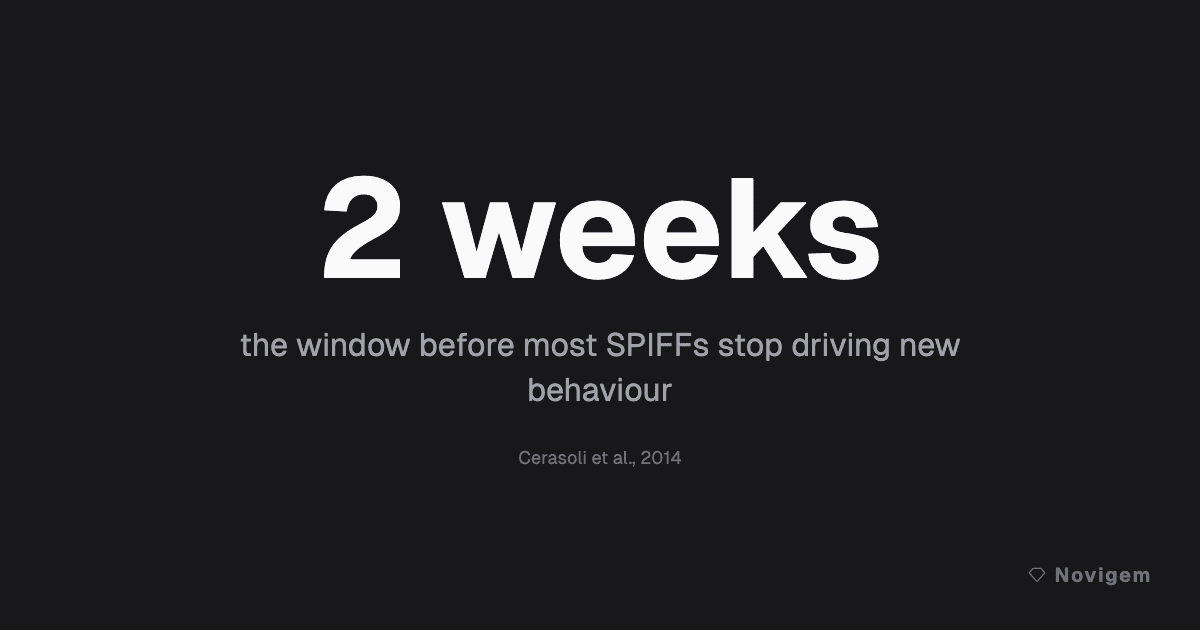
A SPIFF is a one-time cash incentive for a specific sales action. Close this product by Friday, hit this number, book five demos this week. The structure is simple. It is also effective, for about two weeks.
The problem is not the concept. It is the execution and what happens after.
This post covers how to set one up properly in Salesforce, the four design errors that kill most SPIFFs, and what to layer on top if you want the behaviour to outlast the cheque.
What a SPIFF actually is
SPIFF stands for Sales Performance Incentive Fund. It is a short-term bonus paid on top of base commission for hitting a specific, defined target.
The key word is specific. A SPIFF tied to "close more deals" is not a SPIFF, it is just extra commission. A SPIFF tied to "close two Professional tier deals by 31 March" is a SPIFF. The specificity is what creates focus.
SPIFFs are not:
- A replacement for commission structure
- A long-term behaviour change tool on their own
- Effective for outcomes that take longer than a few weeks to reach
They are effective for: clearing end-of-quarter pipeline, driving early adoption of a new product, breaking into a specific segment or deal size, and accelerating activity at the start of a period when pipeline needs building fast.
How to set up a SPIFF in Salesforce
The mechanics are simple. The design decisions are where most go wrong.
Step 1: Define the trigger as Salesforce criteria
The trigger is the specific action or outcome that earns the SPIFF. Write it in a way that removes all ambiguity. "Close any opportunity above £20,000 in the Enterprise segment, Closed Won in Salesforce, between 1 March and 31 March" is a trigger. "Do well this quarter" is not.
In Salesforce, this means specifying exact fields: Opportunity Stage = Closed Won, Amount >= 20000, Close Date within the sprint window, Record Type = Enterprise. If it cannot be filtered in a Salesforce report without a manager's interpretation, it is not specific enough.
Step 2: Build the report before you announce it
Create a report that auto-updates. Every rep eligible for the SPIFF should be able to see their own progress at any time without asking anyone. The report should show current count or amount, where each eligible rep stands, and time remaining.
A dashboard component is better than a shared report. Reps should see their number every time they open Salesforce, not only when they remember to check.
Step 3: Set the duration shorter than feels right
The research on extrinsic incentives is consistent: attention peaks early and decays within two weeks for fixed-term incentives without intermediate feedback (Cerasoli et al., 2014). A SPIFF running for a full quarter loses its urgency by week three. A SPIFF running for two weeks keeps pressure on throughout.
Sprint durations that work: 5 business days, 10 business days, 2 calendar weeks. Anything longer needs weekly checkpoints with visible leaderboard updates to stay live in people's heads.
Step 4: Make progress visible in Salesforce every day
This is where most SPIFFs fail. A manager sends an update email on Friday afternoon. Reps glance at it. By Monday they have forgotten where they stood.
Progress needs to be visible every day, inside the same tool reps use to do the work. Not in a Slack channel they scroll past. In Salesforce, where the behaviour happens.
Step 5: Pay out the same week the sprint ends
The longer the gap between earning and receiving, the weaker the reinforcement. Skinner documented this in 1953. It has not changed.
If the sprint runs Monday to Friday, pay out the following Monday. Not end-of-month payroll. Same-week payout creates a tight loop between the behaviour and the reward. Waiting six weeks severs it completely.
The four design errors that kill SPIFFs
Most failed SPIFFs make the same four mistakes.
The trigger is an outcome, not a behaviour. Tying the SPIFF to "most revenue" rewards whoever had the best pipeline entering the sprint, not whoever changed what they did. Tie it to a specific action: most first meetings booked, most opportunities moved from Proposal to Verbal, most closed-won in a specific product line.
The duration is too long. A 90-day SPIFF is not a sprint. It is a modified quota. The urgency that drives extra effort only works when the deadline feels close and real.
Progress is invisible until the last day. If reps only learn where they stand on the final Friday, the SPIFF produces one week of effort followed by three of coasting. Real-time progress is what sustains activity across the full sprint.
The payout is slow. Two weeks between earning and receiving is long enough for the connection between behaviour and reward to break down. The rep does not associate the bonus with the specific actions that earned it.
What to layer on to make the behaviour last
A well-run SPIFF creates urgency and drives short-term lift. It does not build the habit.
If you want the same behaviour to continue after the SPIFF ends, points for the activity itself, weekly leaderboard resets, and recognition that lands at the moment the behaviour happens, not at the end of the sprint, are what close the gap. The SPIFF breaks the old pattern. The behaviour layer replaces it with a new one.
I covered the research behind why this sequence works in the post on why SPIFFs stop working after two weeks. The short version: extrinsic incentives rent attention. Behaviour systems build the habit.
For the contest formats you can run alongside or instead of a SPIFF, see 27 sales contest ideas organised by the behaviour they build.
Practical checklist before you launch
Before you start:
- Trigger written as exact Salesforce field criteria
- Eligibility list confirmed
- Report built, shared, and auto-refreshing
- Duration set to 1-3 weeks maximum
- Payout date confirmed as the same week the sprint ends
- Communication sent: what earns it, how to track it, when it pays
After the sprint ends:
- Payout processed immediately
- Winner recognised publicly the moment the sprint closes
- Data captured: who improved, by how much, on what
- Decision made: run it again, or switch to a behaviour challenge that compounds over time
The Salesforce gamification guide covers how to structure a programme that combines SPIFFs, challenges, and scoring into something that produces lasting change rather than a one-week spike.
Two posts worth reading before you commit the budget: why SPIFFs stop working after two weeks covers what happens to the behaviour once the payout lands, and 27 sales contest ideas organised by behaviour covers the formats that hold up better over a quarter.
If you want automated tracking and live leaderboards inside Salesforce without a spreadsheet, Novigem handles that natively. Sketch out the programme to see what an always-on version would cost and cover for your team size, or start a 6-week pilot to test whether it moves your specific numbers.