
What Peer-Reviewed Research Actually Says About Sales Gamification
If you've been researching gamification for your sales team, you've probably seen numbers like these: "90% of sales directors say gamification improves performance." "7x increase in conversions." "Gamification market to reach $40 billion by 2027."
Most of them aren't from independent research.
The "90% of sales directors" figure comes from Outfield App, a gamification vendor, surveying 100 of their own customers. The "7x conversions" number is unverifiable. It appears to be a garbled version of a single bank case study that got passed around marketing blogs until nobody remembered where it came from. The market size projections come from firms that sell market research reports to the vendors who then cite them.
None of this is peer-reviewed. None of it is independent.
Here's what the actual research says, including what it doesn't claim.
What Hamari et al. (2014) actually found
The most-cited academic review of gamification research looked at 24 empirical studies across different contexts. The majority showed positive effects on user behaviour. The authors were clear that results were context-dependent: design matters, the population matters, the setting matters.
What they did not find: that gamification always works, or that the positive effects are uniform. Two of the 24 studies found all measured outcomes positive. The rest found mixed results. The honest read of this paper is that gamification has a positive effect in most contexts studied, but how you design it determines whether it works for you.
What Herzig et al. (2015) found
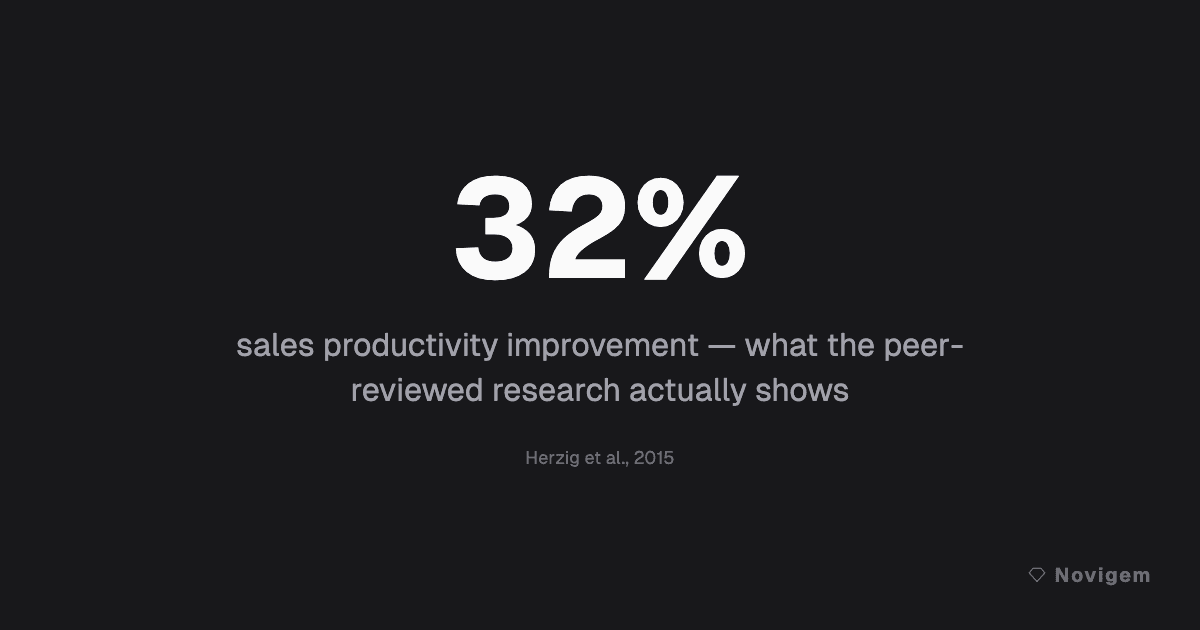
This is the most directly relevant piece of research for B2B sales teams. SAP ran a structured gamification programme for their sales organisation. The researchers compared participants against a control group and found a 32% improvement in sales productivity (Herzig, Strahringer & Ameling, 2015, cited in Ahmed 2025).
That's real research, with a control group, in an enterprise sales context. It's the strongest evidence available that well-designed sales gamification produces measurable results.
What it doesn't tell you: whether the result would replicate at your company, with your team, at this point in your growth. Single studies are data points. This one is a strong data point. Use it as directional evidence, not a guarantee.
What Liu et al. (2024) found
A more recent study looked at the relationship between engagement and retention in gamified systems. With 405 valid responses, engagement positively correlated with retention at p < 0.001.
This matters because the most common objection to gamification is that engagement fades. The data suggests that when engagement is sustained, retention follows. The design question is what sustains engagement over time.
What the research actually supports
Across the peer-reviewed literature, a few things consistently hold up:
Immediate feedback beats delayed feedback. Points that land on save build habits faster than weekly leaderboard summaries. The connection between action and reward needs to be close in time.
Weekly resets outperform permanent leaderboards. When the gap feels too large to close, lower-ranked participants disengage. Regular resets give everyone a fresh start and keep the competition active for the whole team.
Rewarding behaviour beats rewarding outcomes. SPIFFs reward closing deals. Gamification that scores daily activity rewards the logging, the contact role, the close date update. That's the work that builds pipeline. The research on continuous reinforcement supports this approach over one-off outcome rewards.
Context always matters. The same design that works for a 20-person SaaS team may not work for a 200-person enterprise team. Team size, deal complexity, and management quality all affect outcomes.
How to read a gamification stat
The next time you see a gamification statistic in a vendor's marketing, ask: is this a vendor survey? A market research report? A single case study presented as universal? Or a peer-reviewed study with a control group?
The evidence base for well-designed sales gamification is solid. You don't need the inflated vendor numbers to make the case. The real research is strong enough on its own.
For a practical walkthrough of how these mechanisms apply in Salesforce, see our guide on how to gamify Salesforce. For the full set of sourced figures, see the sales gamification and CRM adoption statistics.
Novigem is built on the mechanisms the research supports: immediate reinforcement, weekly resets, behaviour scoring rather than outcome scoring. See how it works.